A live online session at 7 pm can be ideal for one learner and impossible for another. Someone practising Qigong may value immediate feedback on posture, while a busy professional learning website design may need to study after work, in shorter sessions. The phrase synchronous asynchronous learning describes the two main ways courses can be delivered, and choosing between them affects far more than a timetable.
The most useful question is not which method is better. It is which method gives learners enough structure, support and practice to make real progress alongside the demands of everyday life. For many adults, the answer is a thoughtful combination of both.
What is synchronous and asynchronous learning?
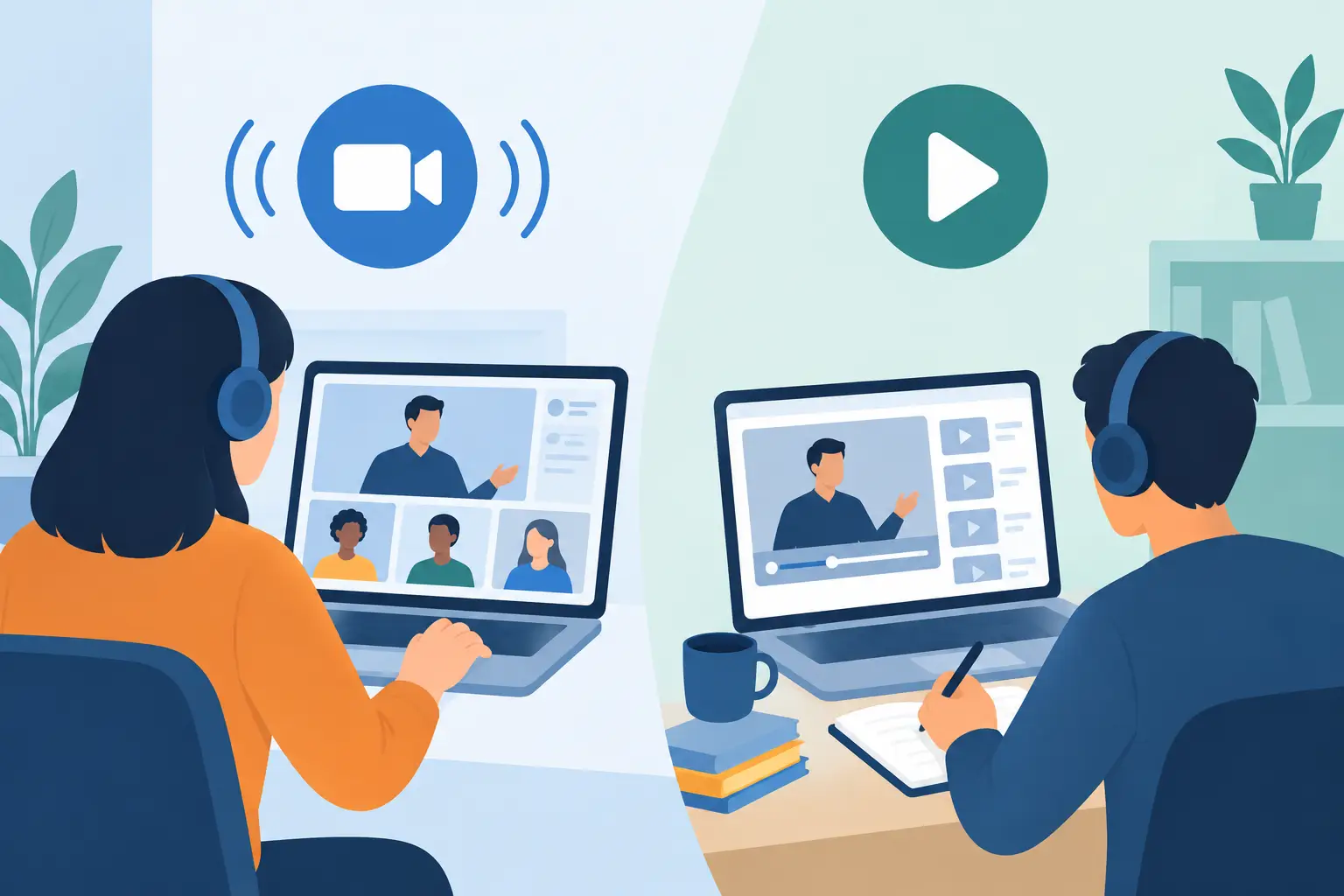
Synchronous learning happens when learners and a tutor take part at the same time. This might be a scheduled Zoom lesson, a live online workshop, a group discussion, or an on-site training session. Everyone is present together, even if they are in different locations.
Asynchronous learning allows people to engage with course materials at different times. Learners may work through recorded videos, reading, activities, quizzes and practical tasks when it suits them. They do not need to attend a particular class at a fixed hour to continue.
The distinction is simple, but the experience is not. A course can include asynchronous modules while also offering a live one-to-one support session. Equally, a live course may provide recordings, worksheets and follow-up tasks for independent study. This is often called blended learning, and it can offer a more realistic fit for adult learners than either approach alone.
The value of learning together in real time
The strongest feature of synchronous learning is direct interaction. Learners can ask a question as soon as it arises, receive clarification and hear the questions other people are asking. For subjects where practice, confidence and feedback matter, that immediacy can be particularly valuable.
A live personal safety session, for example, gives an instructor the opportunity to correct technique and respond to concerns sensitively. In communication training, learners can practise speaking, listening and responding under guidance rather than only reading about the theory. A live Tai Chi or Qigong lesson can help participants refine movement safely, especially when they are new to the practice.
Scheduled learning also creates useful accountability. It is easier to protect time for development when it appears in the diary as a commitment. Some learners find that a regular class gives them momentum, particularly when they are returning to study after a long break or tackling a subject that feels unfamiliar.
There are trade-offs. Fixed sessions can be difficult for people with shift work, caring responsibilities, variable health, overseas time zones or unreliable availability. Group sessions may move at a pace that is not quite right for every participant. Live delivery works best when attendance is practical and interaction genuinely adds value to the learning outcome.
When synchronous learning is particularly useful
Real-time teaching is often a good choice when a learner needs to demonstrate a skill, receive individual feedback or build confidence through guided practice. It also suits organisations that want a team to develop a shared understanding, discuss workplace scenarios and agree practical next steps together.
However, live contact does not have to mean a large class. A scheduled one-to-one session can be more appropriate for learners who want personalised guidance, have a specific barrier to overcome or prefer a quieter space to ask questions.
Why asynchronous learning gives adults more control
Asynchronous learning is built around flexibility. A learner can pause a video, repeat a complex section, make notes and return to an activity without feeling that they are holding up a group. This makes it well suited to subjects that benefit from steady, independent practice.
Someone learning programming may need time to test code, find errors and try again. A learner developing English language skills may want to replay pronunciation examples several times before responding. Stress-management materials may be more useful when accessed at the point a person has a quiet moment to reflect and practise.
This format can make training more accessible too. Learners can work at a pace that reflects their confidence, concentration and previous experience. There is no need to travel, and there may be less pressure for those who feel anxious about contributing in front of others.
The challenge is that flexibility requires self-direction. Without a planned routine, even an excellent course can be postponed repeatedly. Learners may also miss the reassurance that comes from speaking to a tutor or comparing experiences with peers. Asynchronous learning should not mean unsupported learning. Clear instructions, realistic milestones and access to help make a significant difference.
Blended delivery is often the practical answer
For many course subjects, the best design combines independent learning with scheduled support. Learners can complete core materials when convenient, then use a live session to ask focused questions, practise a skill or discuss how to apply what they have learned.
This approach makes tutor time more purposeful. Instead of spending a full session covering information that could be read or watched independently, the session can focus on areas where human guidance has the greatest value. That may include feedback on a website project, coaching for a presentation, adapting wellbeing techniques or resolving a technical problem.
A blended approach also gives learners a route back into the course if life interrupts their plans. They can revisit materials after illness, work pressures or holidays, while knowing that personal support is available when they need it. At Training The Wright Way, this balance of online modules and one-to-one support helps learners keep flexibility without feeling left on their own.
How to choose the right learning format
Start with the skill you want to develop. If the outcome depends on physical technique, conversation, role-play or immediate correction, include some live learning. If it depends on absorbing information, building familiarity or completing individual practical tasks, asynchronous materials may be more efficient.
Next, be honest about your routine. A fixed class can be motivating, but only if you can attend consistently. If your working pattern changes from week to week, independent modules may be more realistic. You can still arrange occasional tutor support rather than committing to a regular group session.
It is also worth considering how you learn when you get stuck. Some people are happy to research, experiment and return to a task later. Others lose confidence quickly without reassurance. Neither approach is better. The right course should provide enough guidance for your needs, whether that means live teaching, tutor contact, detailed feedback or clearly structured materials.
For organisations, the decision may depend on operational constraints as much as learning preference. On-site or live group training can create a shared experience and allow discussion of specific workplace situations. Yet a programme with independent elements may reduce time away from daily responsibilities and help staff revisit key content after the session.
Making either approach work well
Learners can improve the value of asynchronous study by setting a regular, manageable slot each week. It is better to complete two focused sessions of 30 minutes than to wait for a free afternoon that never arrives. Keep notes on questions as they occur, and use available support sessions to address them rather than letting uncertainty build.
For synchronous sessions, prepare in advance. Review any materials provided, test your device and connection, and arrive with one or two questions or goals. If a practical task is involved, create enough space to participate comfortably. These small preparations leave more time for the part of live teaching that matters most: useful interaction.
Course providers have responsibilities too. Instructions should be clear, activities should relate to real goals, and learners should know how to get help. Flexibility is valuable only when it is paired with a route through the learning, not when people are simply given content and expected to manage alone.
The best learning format is the one you can attend, engage with and apply. Choose a structure that respects your time while giving you the right moments of challenge, feedback and encouragement to keep moving forward.