
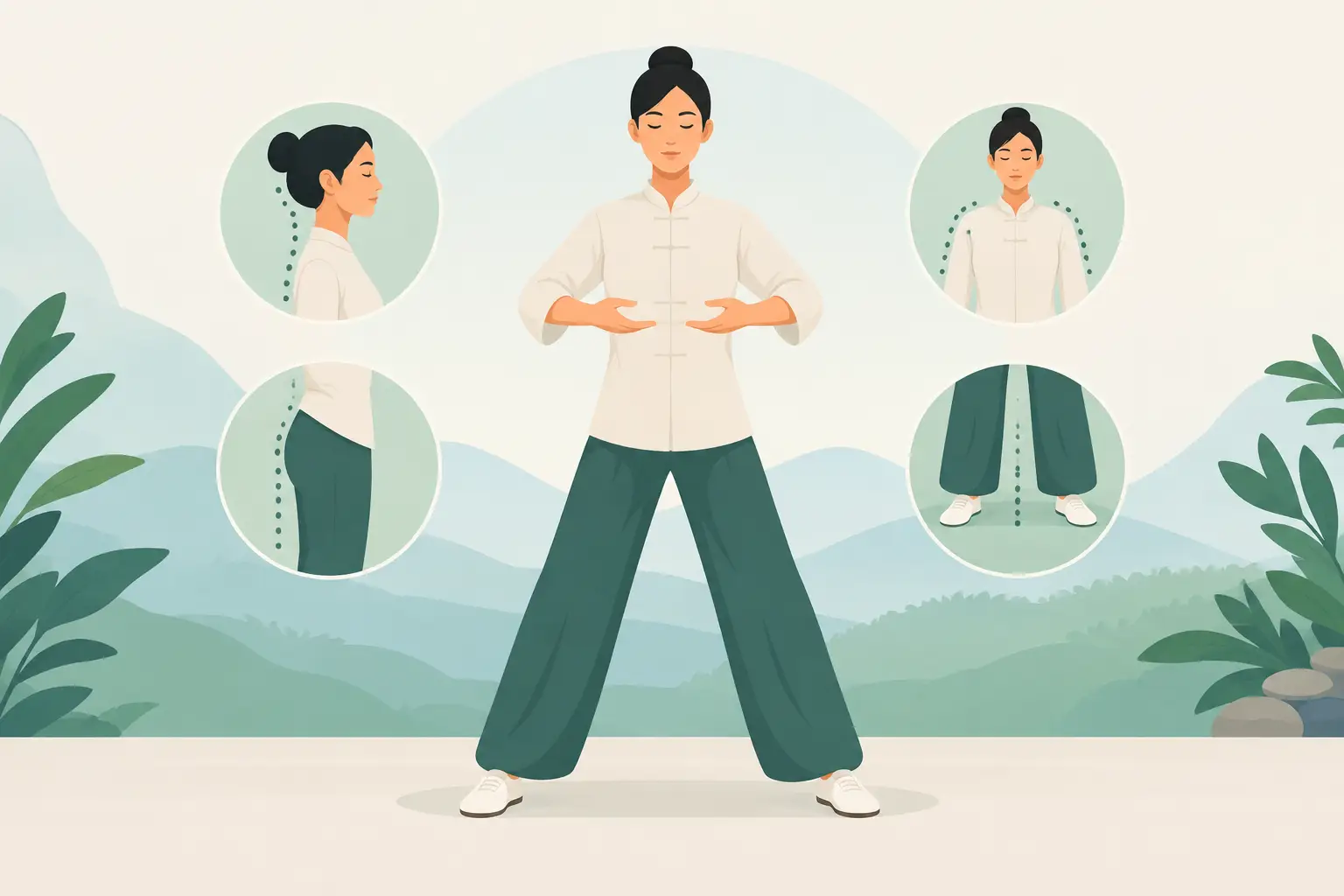
A Qigong posture can look simple from across the room: feet planted, arms relaxed, breathing unforced. Yet the small details determine whether a practice feels grounding and comfortable or leaves you with tight knees, a sore lower back and the sense that you are merely holding a shape. This Qigong posture alignment guide gives you practical checks for building positions that support calm attention rather than strain.
Good alignment is not about standing rigidly straight. It is about organising the body so that your joints can share the work, your breath has room to move and your mind can settle into the exercise. People have different proportions, mobility levels and health considerations, so there is no single pose that every learner must copy exactly.
Start with a balanced standing position
Many Qigong exercises begin in a natural standing posture, often called Wuji. Stand with your feet roughly hip-width apart, or a little narrower if that feels more secure. Your weight should be spread across both feet, without gripping your toes or leaning heavily into your heels.
Let the knees soften. This does not mean dropping into a squat. A slight release prevents the legs from locking and allows the hips and ankles to make the small adjustments needed for balance. If you have knee pain, use a higher stance and keep the bend minimal. Comfort is useful information, not something to push through.
Allow the pelvis to rest in a neutral position. Many beginners either tip the tailbone too far under or arch the lower back in an effort to look upright. Instead, imagine the pelvis as a bowl of water that you do not want to spill forwards or backwards. The lower back should feel long and easy, not flattened or forced.
Use the head, spine and chest as gentle reference points
The spine does not need to become a perfectly straight line. It has natural curves, and Qigong works best when those curves are allowed rather than corrected aggressively. Think of lengthening upwards through the crown of the head while letting the body settle down through the feet.
Keep the chin slightly drawn in, as though you are making space at the back of the neck. Looking too high can compress the neck, while dropping the head can round the upper back and restrict breathing. Your gaze can rest softly ahead or slightly down, depending on the exercise and your balance.
Let the chest soften rather than being pushed out. This is sometimes described as relaxing the chest and gently widening the upper back. It can feel unfamiliar if you are used to standing with the ribs lifted, but it gives the shoulders and breath more freedom. You should still be able to breathe comfortably into the lower ribs and abdomen.
Release the shoulders and elbows
Shoulder tension is one of the most common obstacles in Qigong. Check whether your shoulders have crept towards your ears. Let them drop without pressing them down. The difference is subtle: pressing creates another kind of tension; releasing allows the upper body to feel supported by the spine.
When the arms are held in front of the body, leave a small curve at the elbows. Locked elbows transfer pressure into the joints and make movements look stiff. Keep the wrists long and neutral where possible, with fingers comfortably extended rather than spread as wide as they will go.
If raising the arms causes discomfort, lower them. The quality of attention and ease matters more than achieving a prescribed height. A person with restricted shoulder movement may gain more from practising a smaller, well-aligned version of the movement than from forcing their hands to chest level.
A practical Qigong posture alignment guide for moving practice
Alignment changes slightly once you begin stepping, shifting weight or circling the arms. The aim is not to freeze the body but to maintain a clear relationship between the feet, knees, hips and torso.
As weight moves to one leg, make sure the knee broadly follows the direction of the toes. It does not need to be held in one fixed line, but it should not collapse sharply inwards. Keep the supporting foot connected to the floor through the heel, the base of the big toe and the base of the little toe.
Turn from the hips and waist rather than twisting the knees. In flowing exercises, let the pelvis and ribcage participate in the turn while the head follows naturally. If your feet stay fixed and you rotate too far through the upper body, the lower back may complain. Reduce the range until the movement feels smooth.
Move at a pace that lets you notice where your weight is. Rushing often leads to leaning, overreaching and lifting the shoulders. Slower practice is not automatically better, however. If moving very slowly makes you tense, choose a calm but natural rhythm and gradually develop control.
Check your alignment without interrupting the practice
A mirror can help at the beginning, particularly for noticing uneven shoulders or a habitual lean. It is not essential, and relying on it throughout every session can pull attention away from internal sensation. Try using it briefly, then practise facing away from it and sense your position.
A useful self-check takes only a few seconds. Feel both feet on the ground. Soften the knees. Let the pelvis settle. Lengthen through the crown of the head. Release the jaw, shoulders and hands. Then return to the movement or standing exercise.
Breath is another reliable guide. If you cannot breathe freely, if you are holding your jaw tight, or if your lower back feels braced, reduce the effort. In Qigong, a smaller movement with steady breathing is often more beneficial than a larger movement done with tension.
Common corrections that can make posture worse
Trying too hard to be upright can create a stiff, military stance. Trying too hard to relax can lead to slumping. The middle ground is alert but unforced: the body has shape, but it is not being held together by muscular effort.
Avoid pushing the knees out excessively, gripping the buttocks, tucking the pelvis hard or pulling the shoulders back throughout an exercise. These instructions may occasionally be useful as short corrections for a particular habit, but they are rarely helpful as permanent positions. After making a correction, find the smallest amount of effort that keeps you comfortable and supported.
It is also worth avoiding the idea that pain proves you are making progress. Mild muscular awareness can be normal when learning a new stance. Sharp pain, tingling, dizziness or increasing joint pain are reasons to stop, rest and seek appropriate professional advice if symptoms continue.
Adapt the stance to your body and setting
Qigong is accessible partly because it can be adjusted. If standing is tiring, practise beside a stable chair so you can lightly use it for support. Some exercises can be performed seated, with both feet resting on the floor and the spine comfortably upright. A seated practice is not a lesser practice when it allows you to breathe, focus and move with control.
Choose footwear and a surface that help you feel stable. Bare feet may suit some people at home, while flat, supportive shoes may be more appropriate in a hall or outdoor setting. Avoid slippery socks and cramped spaces where you are worried about knocking into furniture.
For learners with arthritis, balance concerns, past injuries or long-term conditions, individual guidance can be particularly valuable. An experienced instructor can help adapt stance width, arm height and movement range without losing the purpose of the exercise. Training The Wright Way offers learner-centred Qigong tuition with the flexibility to ask questions and develop practice at a manageable pace.
Give your posture time to become familiar
Postural awareness develops through repetition, not constant correction. Begin each session by taking a minute to find your feet, soften unnecessary effort and settle your breathing. During the practice, choose one area to notice, such as the shoulders or knees, rather than trying to monitor everything at once.
Over time, the best sign of progress is usually not a more dramatic-looking stance. It is the ability to stand and move with greater steadiness, comfort and attention. Let that feeling of ease be the useful closing thought you carry from practice into the rest of your day.