
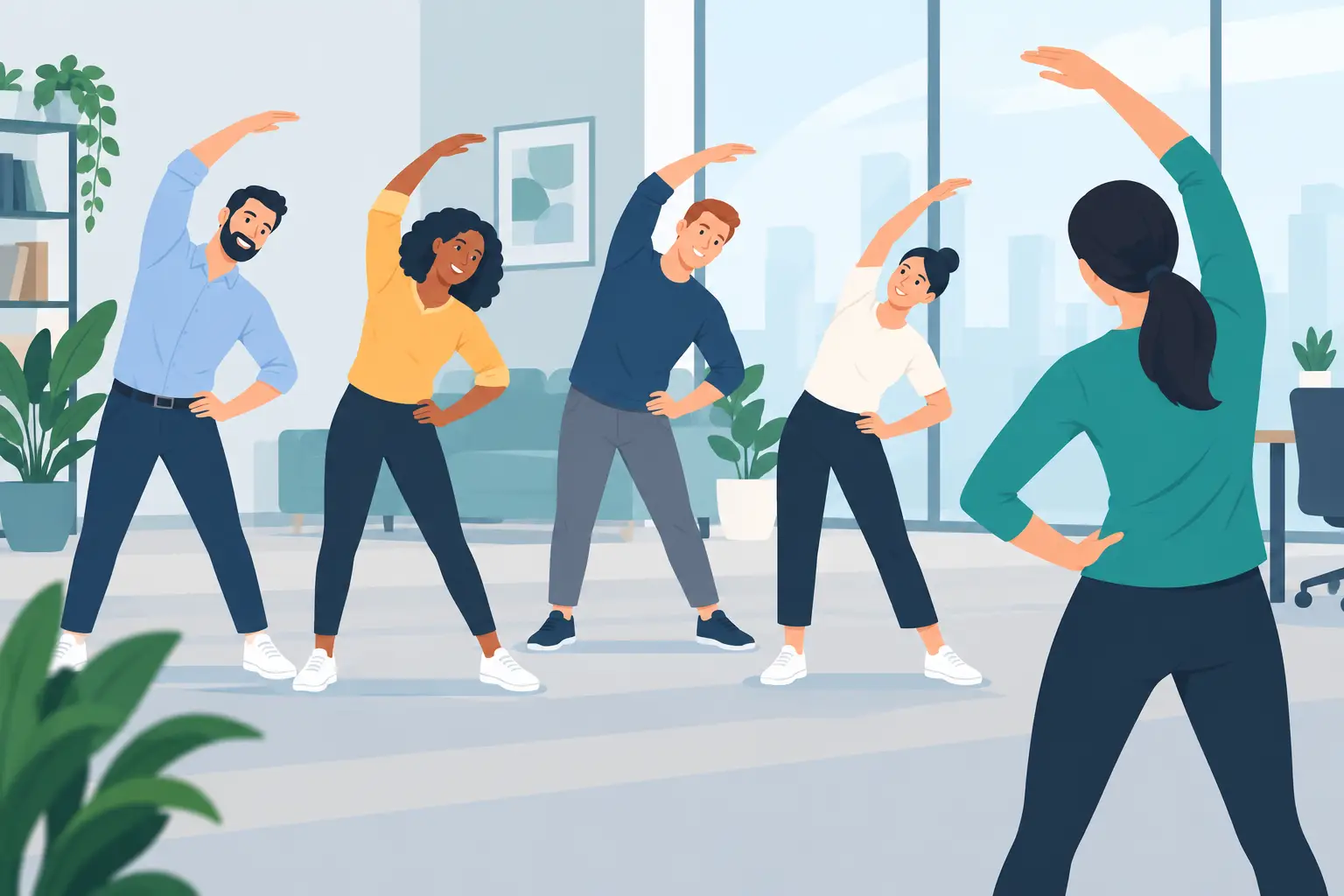
A wellbeing initiative can look impressive on a staff newsletter yet make very little difference at 3pm on a pressured Tuesday. The difference is whether people leave with a practice they can use in the moment: a way to settle their breathing before a difficult conversation, move after hours at a desk, or speak more clearly about what support they need. Group training for workplace wellbeing is most useful when it treats wellbeing as a practical workplace skill rather than a one-off perk.
For organisations, the appeal is clear. A shared session gives colleagues common language, time to practise together and an experience that does not rely on individuals finding the answer alone. For employees, it can feel more approachable than being told to manage stress independently outside working hours. However, results depend on the subject, the way the session is delivered and whether the organisation makes room for healthier habits afterwards.
Why group learning can support wellbeing
Work affects wellbeing through more than workload alone. Unclear expectations, prolonged screen time, difficult interactions, isolation, lack of confidence and competing responsibilities can all add pressure. A single workshop will not remove structural problems, and it should never be used to avoid addressing them. It can, though, give a team useful tools while creating an informed conversation about the conditions people are working in.
Learning as a group has a particular advantage: it normalises participation. When colleagues practise a simple breathing exercise, discuss boundaries around communication, or learn safe ways to reduce physical tension together, the activity becomes part of the team’s shared experience. People are not singled out as though they are struggling or failing to cope.
There is also value in learning from an experienced instructor in real time. Participants can ask questions, adapt movements to their own comfort and check they have understood a technique correctly. This matters particularly for physical wellbeing activities, where accessibility and individual ability need thoughtful consideration.
Choosing the right group training for workplace wellbeing
The best course is not necessarily the most energetic or fashionable one. It is the one that fits the people attending and the working reality they return to afterwards. Begin with a simple question: what would make day-to-day work feel more manageable for this group?
A team coping with sustained deadlines may benefit from stress management training that covers recognising pressure, setting realistic priorities and using short reset techniques. A desk-based workforce may respond well to gentle Tai Chi or Qigong, where controlled movement, posture and breathing can be practised without needing specialist fitness levels. Teams facing frequent public contact or challenging situations may need personal safety training alongside clear organisational procedures and support.
Communication can also be a wellbeing issue. When people are unsure how to raise concerns, ask for clarification or handle disagreement respectfully, stress often builds quietly. Training that develops confidence, listening and clear communication can therefore support a healthier working environment, even if it is not labelled as a wellbeing course.
It depends on the group. Avoid assuming that one activity will suit everyone, or that people want to share personal experiences in front of colleagues. A good provider will discuss the group’s needs, the workplace setting, participant numbers and any access requirements before recommending a format.
Make accessibility part of the planning
Wellbeing training should not create a new barrier for the very people it is meant to support. Ask in advance about mobility needs, neurodiversity, hearing or visual access, language confidence, religious considerations and whether colleagues can comfortably take part in movement-based activities. Provide alternatives rather than making assumptions.
For example, Qigong can often be adapted for seated participation, while stress management sessions can include quiet individual reflection instead of requiring everyone to speak to the room. Clear instructions, an unhurried pace and materials that can be revisited later all help people engage with confidence.
From a good session to lasting practice
The common weakness of workplace wellbeing programmes is not poor intention. It is lack of follow-through. People may enjoy a session, then return immediately to a diary with no breaks, messages late into the evening or a culture where asking for help is quietly discouraged.
A more useful approach is to connect training with small, visible changes. Managers might protect a short break between meetings, agree expectations for response times, start a weekly team meeting with a brief check-in, or make space for a regular movement session. These are modest steps, but they show that the organisation values the practice rather than merely the event.
Participants also need permission to use what they learn. A breathing technique is easier to remember when it is introduced as something to use before a presentation, after a demanding call or during a short pause between tasks. Tai Chi and Qigong movements are more likely to continue when staff know they can be done in ordinary work clothes, in a meeting room or at home between online meetings.
For groups of around six to eighteen participants, on-site training can offer a particularly practical balance. The instructor can observe the space, respond to the group and keep the session interactive without making it feel too exposed. Where teams work across locations or shifts, online delivery and personalised follow-up support may be the better choice. Blended provision can help organisations include more people without losing the opportunity for direct questions.
What managers should do before the course begins
Managers set the conditions for participation. If a course is presented as optional but staff feel unable to step away from urgent work, attendance may be poor or distracted. If it is framed as a response to people not being resilient enough, trust will disappear quickly.
A stronger message is straightforward: the organisation recognises that work can be demanding, wants to provide useful skills and is prepared to consider what needs to change around the training. Let staff know what the session involves, how long it will last, whether movement is included and what alternatives are available. Give people adequate notice and make participation time part of the working day where possible.
It is also wise to define the purpose without promising outcomes that cannot be guaranteed. Training may help people develop coping strategies, confidence and shared understanding. It is not a substitute for clinical care, occupational health advice, fair workloads or effective management. Being clear about these boundaries is both responsible and reassuring.
How to evaluate whether it helped
Attendance alone is a weak measure. A full room may show interest, but it does not tell you whether the training was relevant or usable. Gather feedback soon after the session, using questions that focus on practical value: what felt useful, what was unclear, and what would help participants apply the learning at work?
Then check back after several weeks. Are people using any of the techniques? Has the team adopted a helpful routine? Have managers noticed better conversations about pressure, breaks or support? Qualitative feedback is valuable here, especially for smaller groups, because it can reveal barriers that a score out of ten will miss.
Training The Wright Way can tailor group-based sessions to the needs of organisations, combining experienced instruction with flexible online or on-site delivery. The right format should reflect the people in the room, not simply the course title on a booking form.
A worthwhile wellbeing session gives people something they can carry into the next difficult moment. Choose training that respects different needs, allows time for practice and is backed by everyday workplace habits. That is where a supportive intention starts to become a better way of working.