
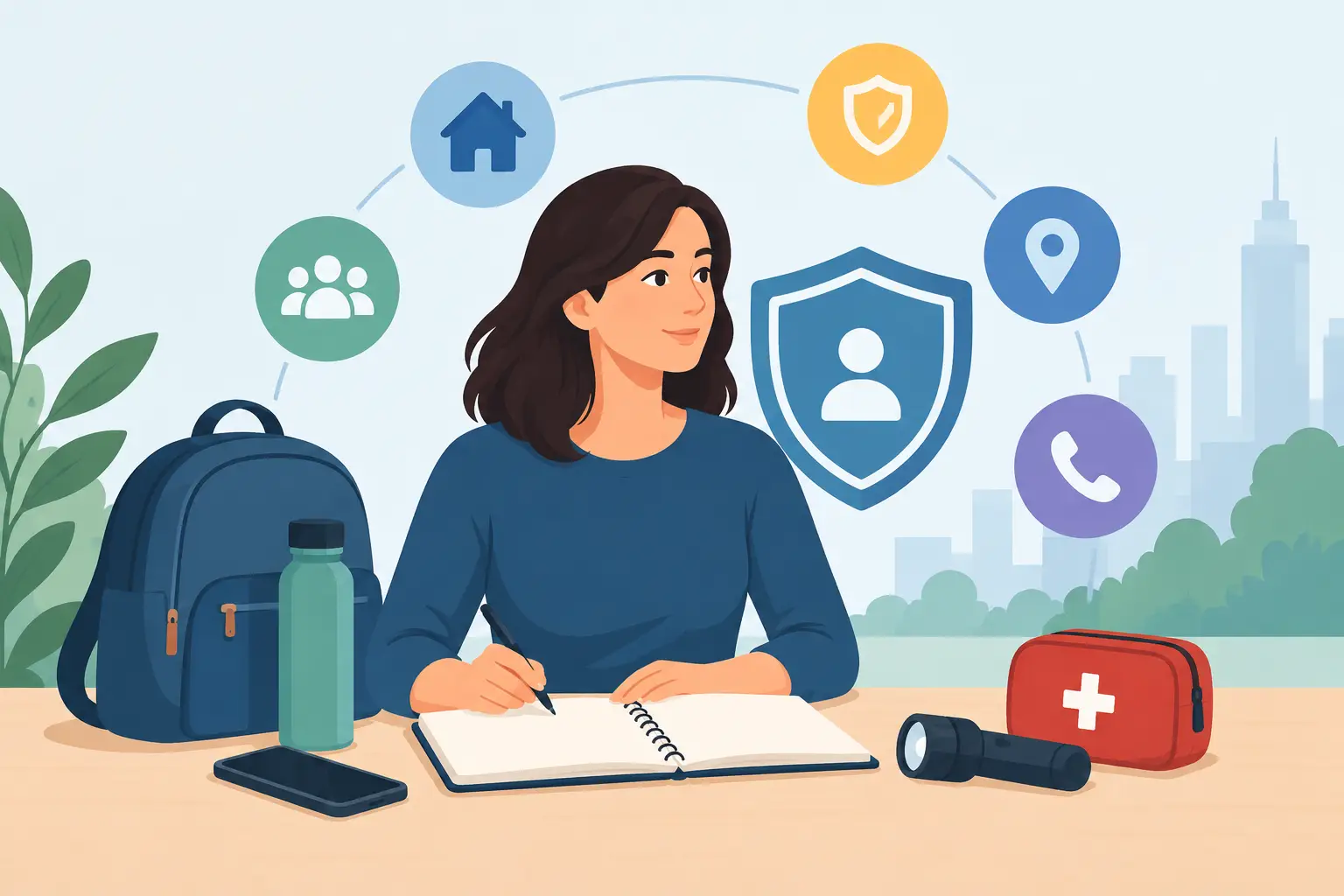
A personal safety plan is most useful before you urgently need one. It is not about expecting the worst or limiting your independence. It is a practical way to make a few clear decisions while you are calm, so you have options if a situation feels unsafe at home, while travelling, at work or online. To create a personal safety plan, start with your own routines rather than a generic checklist.
A good plan does not promise that risk can be removed completely. It can, however, reduce uncertainty, help you act earlier and make it easier to ask for help. The best version is simple enough to remember, realistic for your life and reviewed whenever your circumstances change.
How to create a personal safety plan
Begin by considering the places, journeys and situations that form part of a normal week. You may feel entirely comfortable in most of them. The aim is to identify the points where a small amount of preparation would make you feel more confident.
For some people, this may be travelling home after an evening shift. For others, it may be meeting new clients, attending social events, using dating apps, living with someone whose behaviour feels unpredictable, or managing unwanted contact online. A plan should reflect your experience, not somebody else’s idea of what you should worry about.
Map your routines and possible exit routes
Think through your regular locations: home, workplace, car, public transport routes, car parks, shops and places you visit socially. In each place, consider where you could go if you needed support, how you could leave, and who might be nearby.
At home, this could mean keeping keys, a charged mobile phone and essential medication where you can reach them quickly. If you share a home with someone who makes you feel unsafe, consider an exit route that does not involve rooms with potential weapons or restricted exits, such as a kitchen or bathroom. If there is immediate danger, call 999. In the UK, 112 also connects to emergency services.
For journeys, choose routes you know where possible, and have a back-up option if public transport is delayed or a lift arrangement changes. This might include the number of a licensed taxi firm, enough battery on your mobile phone and a contact who knows when you expect to arrive. There is a trade-off here: sharing every movement can feel intrusive, while sharing key travel details with a trusted person can offer reassurance. Decide what feels proportionate for you.
Decide what you will do when something feels wrong
People often imagine safety as physical self-defence, but early decisions are frequently more valuable. If a person, place or conversation makes you uneasy, you do not need to wait for proof that something is wrong before leaving, declining, creating distance or asking for help.
Write down a few actions that suit different levels of concern. For example, if you feel uncomfortable, you might move towards other people, call a friend or use a prepared reason to leave. If you are being followed or threatened, go to a busy, well-lit place such as a shop, station or reception area, and ask staff or bystanders for help. If you are in immediate danger, contact emergency services.
Simple wording can reduce hesitation. You could practise phrases such as: “No, I am not comfortable with that”, “I need to leave now”, or “Please stay with me while I make a call.” Being polite is never more important than getting to safety. Your plan should give you permission to act on concern without having to justify it.
Choose trusted contacts and agree how to communicate
Select at least two people you could contact. They may be friends, relatives, neighbours, colleagues or a support worker. Choose people who will take you seriously, respect your privacy and respond calmly. A contact who is kind but unreliable may not be the right person for an urgent situation.
Agree what help you may ask for. One person may be able to collect you, while another may be better placed to stay on the phone, keep a spare key or contact services if you stop responding. Consider a short code word or phrase that sounds ordinary but signals that you need help. Make sure everyone involved understands exactly what it means and what action they should take.
Keep important numbers available somewhere other than your mobile phone as well. A written copy in a wallet, bag or private notebook can be useful if your battery fails, your mobile phone is lost or you cannot access it safely.
Include digital safety without making life harder
Digital safety belongs in a personal plan because mobile phones, apps and accounts can reveal more than we intend. Review who can see your location, posts and contact details. Use strong, separate passwords for key accounts, turn on two-step verification where available and avoid sharing verification codes with anyone.
If unwanted messages or online harassment occur, save evidence where it is safe to do so. Screenshots, dates and account names may be useful if you decide to report the behaviour. Block and report accounts when appropriate, but seek specialist advice first if blocking could increase risk in an ongoing abusive situation.
Privacy must be balanced with practicality. Turning off location sharing may be sensible in one circumstance, but a trusted contact may need it during a late journey. Review settings deliberately rather than assuming one approach works for every situation.
Put your personal safety plan into a usable format
A detailed document is not always helpful under pressure. Create a short version that can be read in seconds, with essential contacts, your code word, safe places, travel back-ups and the first action you will take if you feel at risk. Keep it private and accessible.
A plan may include the following practical details:
- emergency and non-emergency contact numbers, including 999 and 101 where relevant
- two trusted contacts and what each person has agreed to do
- safe places near home, work and regular travel routes
- a small list of essentials to take if you need to leave quickly
- digital privacy checks and any evidence you need to keep safely
Avoid storing sensitive details where another person can easily find them if that could put you at greater risk. Depending on your circumstances, a password-protected note, a paper copy held by a trusted person or a memorised plan may be safer than a visible document.
Practise calmly, then update when life changes
You do not need to rehearse frightening scenarios in detail. Instead, practise the practical parts: charging your mobile phone, finding an alternative route, saying a boundary phrase aloud, or checking that a trusted contact still has the right number. Familiarity makes a plan easier to use without panic.
Review it after a house move, new job, relationship change, change in health, new caring responsibilities or a shift in travel patterns. Accessibility matters here. If you use mobility equipment, rely on medication, have hearing or visual impairments, experience anxiety, or need communication support, plan around what will genuinely work for you. This may mean identifying accessible safe spaces, keeping a medical information card or agreeing a preferred communication method with trusted people.
Build confidence through practical skills and support
A safety plan works best alongside skills that help you notice risk, communicate clearly and manage stress responses. Personal safety training can provide a structured place to practise awareness, assertiveness, boundary-setting and decision-making without pressure to perform or prove yourself.
Training The Wright Way supports learners who want practical, adaptable personal safety education, including options that fit around work and personal commitments. The right support should leave you better informed and more confident, not more fearful.
Keep your plan focused on one question: if something does not feel right, what is the safest realistic next step I can take? Having that answer ready can make everyday independence feel more manageable.